
ACE Data Customs Entry Review: How U.S. Importers Audit, Correct, and Protect Their CBP Filings
By Jeb Singer, Managing Partner, Singer Law Group and Co-Founder, Singer Tariff Recovery
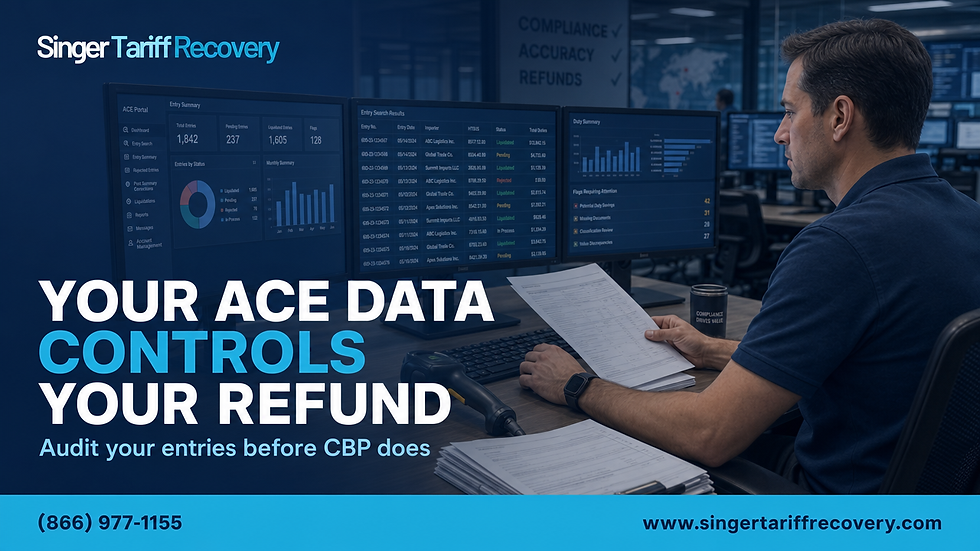
Many importers assume their customs broker handles everything correctly once an entry is filed. Unfortunately, that assumption can become expensive.
An ACE data customs entry review allows a business to confirm that its customs entries were filed accurately, identify recoverable duty overpayments, and uncover issues before they escalate into CBP enforcement problems. For companies pursuing IEEPA tariff refunds, it is one of the most important steps in the process.
ACE, the Automated Commercial Environment, is the system U.S. Customs and Border Protection uses to process import transactions. Every customs entry, duty payment, classification, valuation, and importer record is stored there. While a customs broker may prepare and submit the paperwork, the legal responsibility for the information belongs to the Importer of Record.
That distinction matters.
If an entry contains incorrect information, the importer, not the broker, is generally responsible for correcting it. Likewise, when a business seeks to recover duties through the CAPE refund process, the quality of its ACE data often determines whether a claim moves forward smoothly or encounters avoidable delays.
A thorough review before filing gives businesses an opportunity to identify problems early, organize supporting documentation, and strengthen their refund claim before it reaches CBP.
What Is ACE and Why Does It Matter?
ACE is where CBP keeps the official record of your imports.
Every customs entry, duty payment, product classification, and importer record flows through this system. If your business imports goods into the United States, ACE contains the information CBP relies on when reviewing your entries.
Many importers never see it because their customs broker handles the filings.
Even so, the responsibility for accurate reporting belongs to the Importer of Record. If an entry contains incorrect information, your business,not your broker, is responsible for correcting it.
That is why reviewing ACE data has become an important part of both customs compliance and tariff recovery.
For businesses seeking IEEPA tariff refunds, the same information CBP uses to review refund claims is available directly in ACE. Errors that have gone unnoticed for months or even years can become obstacles in the refund process if not identified beforehand.
Key Terms
Automated Commercial Environment (ACE)
ACE is CBP's online system for managing import transactions. It stores information associated with your customs entries, including product classifications, declared values, duty payments, and entry history. If you're reviewing imports or pursuing a tariff refund, this is where the information starts.
Importer of Record (IOR)
The Importer of Record is the business or individual legally responsible for the goods being imported into the United States. While a customs broker may prepare and submit the paperwork, the Importer of Record is ultimately responsible for making sure the information filed with CBP is accurate.
Entry Summary
The Entry Summary is the official customs record for an imported shipment. It includes the products that entered the country, their classifications, the values reported to CBP, and the duties paid. This is one of the first documents reviewed when evaluating a tariff refund opportunity.
How Do You Access and Review Your ACE Data?
Businesses can access their customs information through the ACE Secure Data Portal after establishing an account with CBP and obtaining the appropriate user permissions. Many companies also work with their customs broker to obtain reports and entry records directly from the system.
Once you've gathered your ACE records, take a close look at what's actually on file.
Review the tariff classifications first. An incorrect HTS code can affect duty calculations across multiple shipments.
Next, compare the declared values with your invoices and purchasing records to ensure the numbers match.
Then verify the country of origin for each entry. Something as simple as an incorrect origin can affect duty rates and refund eligibility.
Before filing anything with CBP, confirm that the Importer of Record information matches the business that paid the duties. Businesses that have changed names, reorganized, or updated their tax information often discover records that need correction first.
It is also worth reviewing payment information, including ACH details, to help ensure approved refunds can be processed without unnecessary delays.
A careful review now is often much easier than correcting problems after a claim has already been submitted.
What Are the Most Common ACE Entry Errors That Trigger CBP Scrutiny?
Even businesses that import regularly can have errors in their ACE records. Some are simple data-entry mistakes. Others involve product classifications, customs values, or country-of-origin information that can affect duty calculations across multiple shipments.
An ACE data review is designed to identify these issues before they create larger problems.
One of the most common issues involves the Harmonized Tariff Schedule (HTS) classification. If merchandise is assigned the wrong HTS code, the duties paid may be higher or lower than they should have been. That can affect eligibility for tariff refunds and may also create compliance concerns if CBP determines the entry was inaccurate.
Take a close look at the declared values as you review your entries. They should match your invoices and the records supporting each shipment. If they don't, that issue is easier to address before a claim reaches CBP.
Next, verify the country of origin. The country listed on the entry affects the duties paid and can influence whether certain tariff programs apply. Even a single mistake can affect multiple imports.
Finally, confirm that the Importer of Record information is accurate from beginning to end. Businesses that have changed their legal name, ownership structure, or tax identification often discover records that need updating before moving forward with a refund request.
Finally, payment information should not be overlooked. Incorrect banking information or missing ACH details can delay payment even after a refund has been approved.
Most of these issues are fixable. The key is finding them before they become part of a larger problem.
Five ACE Data Mistakes That Can Delay a CAPE Refund
Even a strong refund claim can run into delays if the underlying ACE data contains errors. Some of the most common problems are surprisingly easy to avoid with a careful review before filing.
Mistake 1: The Importer of Record Information Doesn't Match
One of the first things to check is the Importer of Record listed in ACE. If your business has changed names, reorganized, or received a new EIN, make sure the records reflect those changes. Small discrepancies can create unnecessary delays when CBP reviews a refund claim.
Mistake 2: Entries Outside the Eligible Filing Period
It's easy to assume every import qualifies for a refund, but that isn't always the case.
Before submitting a claim, confirm that each entry falls within the applicable filing period. Removing ineligible entries at the beginning is much easier than correcting the claim after it's been submitted.
Mistake 3: Banking Information Has Not Been Updated
Once a refund is approved, CBP still needs accurate payment information to issue the funds.
Missing or outdated ACH information can delay payment even after the claim itself has been accepted. Verifying payment details should be part of every ACE review.
Mistake 4: Entry Information Is Incomplete or Inconsistent
Refund requests rely on accurate entry information.
Missing documents, inconsistent entry summaries, or formatting problems can create additional questions during the review process and slow everything down. Taking the time to organize records before filing often prevents these issues altogether.
Mistake 5: Product Classifications Were Never Reviewed
An incorrect tariff classification can affect the duties paid on every shipment involving that product.
If the underlying classification is wrong, the refund analysis may also be affected. Reviewing classifications before submitting a claim helps ensure the refund request is based on accurate customs data rather than assumptions.
How Do You Correct ACE Entry Errors Before CBP Acts First?
Finding an error in your ACE records does not automatically mean you're facing a penalty or losing the opportunity to recover duties. In many cases, businesses have options to correct the record before CBP takes action.
The right approach depends largely on where the customs entry is in the process.
If an entry has not yet been finalized by CBP, corrections may be made through a Post-Summary Correction (PSC). This allows importers to update certain information, correct reporting errors, and address duty calculations before the entry is finalized.
Once an entry has been liquidated, the process changes. If you disagree with CBP's decision, you may need to file a formal protest, and acting promptly is important because the filing deadlines are limited.
In many cases, the issue extends beyond a single entry. Finding the same reporting problem across multiple shipments is often a sign that the entire filing period should be reviewed before deciding on the next step.
The important point is this: correcting an issue early almost always provides more flexibility than waiting until CBP identifies it first.
An ACE review helps determine not only what needs to be corrected, but also the most effective way to address it, based on each entry's current status.
What Is the Legal Responsibility for ACE Data, and Who Is Accountable?
Many businesses rely heavily on their customs broker, and with good reason. Brokers play an important role in preparing and submitting customs entries.
However, the legal responsibility for those filings remains with the Importer of Record.
That often surprises business owners.
Even if a customs broker prepared every document and submitted every entry, CBP generally looks to the Importer of Record when questions arise about classifications, declared values, country of origin, or other information contained in the filing.
For that reason, reviewing your own ACE data is more than a compliance exercise. It gives you the opportunity to verify that the information submitted in your company's name is accurate and complete.
Waiting until CBP raises a question can limit your options. A proactive review allows businesses to identify issues while there is still time to address them, organize supporting documentation, and determine whether corrections are appropriate.
The same review can also uncover opportunities.
Businesses often discover overpaid duties, incorrect classifications, or other filing issues that may support a refund claim. At the same time, the review can identify potential compliance concerns before they become the subject of a government inquiry.
For importers, that makes an ACE review valuable from both sides of the equation. It helps protect against unnecessary compliance issues while also identifying opportunities to recover duties that may have been paid in error.
How Singer Tariff Recovery Conducts ACE Entry Reviews
Every tariff recovery claim begins with the same question:
What does your ACE data actually show?
Before preparing a refund claim, our team reviews the information already on file with U.S. Customs and Border Protection. The goal is to identify potential issues early, confirm that the supporting records are accurate, and determine which recovery options may be available.
The review starts with the customs entries themselves.
We compare product classifications with the imported merchandise, verify the Importer of Record information, review liquidation dates, and confirm that payment information is current. We also look for inconsistencies that could delay a refund request or require additional documentation before filing.
This review often answers important questions before they become problems.
For example:
Are the customs entries eligible for the current refund process?
Are the classifications consistent across similar shipments?
Does the Importer of Record information match the business seeking the refund?
Are there issues that should be corrected before submitting a claim?
Finding these answers at the beginning usually saves time later.
When the review identifies duties that may be recoverable, we help determine the appropriate path forward. Depending on the circumstances, that may involve correcting existing entry information, preparing the necessary documentation, or submitting a refund claim through the appropriate CBP process.
Because every importer's history is different, so is every review.
Some businesses have only a handful of qualifying entries. Others imported products over several years through multiple brokers, ports, or suppliers. Our review is designed to organize that information before the filing process begins so businesses understand both the opportunities and any issues that should be addressed.
Singer Tariff Recovery works with importers throughout New York and across the United States. Our team combines customs recovery experience with the broader commercial and restructuring background of Singer Law Group, giving businesses practical guidance throughout the refund process.
Frequently Asked Questions
What is an ACE data customs entry review?
An ACE data customs entry review is a detailed review of the customs information submitted to U.S. Customs and Border Protection for your imports. It helps verify that product classifications, declared values, country of origin, duty payments, and other entry information are accurate.
For businesses seeking tariff refunds, it is often the first step in determining whether qualifying entries exist and whether any corrections are needed before filing a claim.
How do I access my customs entry information?
Businesses can access their customs records through the ACE Secure Data Portal after registering with CBP and receiving the appropriate account permissions.
Many importers also work with their customs broker to obtain entry reports and historical filing information. Whether the records come directly from ACE or through your broker, reviewing the information carefully is an important part of evaluating refund opportunities and confirming compliance.
What types of errors are commonly found during an ACE review?
Some of the most common issues include:
Incorrect tariff classifications
Customs value discrepancies
Country of origin errors
Importer of Record inconsistencies
Missing or outdated payment information
These issues do not automatically prevent a refund, but identifying them before filing often makes the process much smoother.
How do I correct an error in an ACE entry?
The right solution depends on where the entry is in the customs process.
If the entry has not yet been finalized by CBP, there may be an opportunity to make corrections before liquidation. Once an entry has been liquidated, different procedures and filing deadlines generally apply.
Because every situation is different, it is important to review the entry history before deciding how to proceed. Correcting an issue early can often preserve options that may no longer be available later.
How long can CBP review my import entries?
CBP generally has several years to review import transactions, which means today's entries may still be examined well into the future.
For that reason, businesses should maintain complete import records and periodically review their ACE data rather than waiting until a government inquiry begins.
A proactive review enables businesses to identify potential issues before they become problems.
Can an ACE review help recover overpaid duties?
Yes.
An ACE review often identifies situations where duties may have been overpaid because of classification issues, valuation errors, or other filing discrepancies.
For businesses evaluating IEEPA tariff refund opportunities, reviewing ACE data is one of the first and most important steps. It helps determine which entries may qualify, what documentation is available, and whether any corrections should be made before submitting a refund request.
Every importer's situation is different, but a careful review provides a much clearer picture of the opportunities that may exist.
Start With Your ACE Data
If your business imported goods over the past several years, your ACE records contain the information that drives nearly every customs decision going forward.
Those records may reveal refund opportunities. They may uncover filing issues that need correction. They may also identify compliance concerns before CBP does.
The important thing is knowing where you stand.
At Singer Tariff Recovery, every engagement begins with a careful review of your customs entry history. We review the information already on file, identify potential issues, and help determine the most appropriate path forward for your business and imports.
Whether you're pursuing an IEEPA tariff refund or simply want to better understand your customs filings, starting with your ACE data gives you the information needed to make informed decisions.
If you believe your business may have paid duties that could be recoverable, or if you want an experienced team to review your import history, contact Singer Tariff Recovery to discuss your situation.
A thorough review today can help prevent problems tomorrow and may uncover refund opportunities you didn't know were available.
Call (917) 905-8280 to schedule a confidential consultation with our team.


Comments